Brief Report

Drug checking services can prevent overdose by providing people who use drugs (PWUD) with an opportunity to understand the chemical content of their drugs. In this brief report, we share perspectives from clients of drug checking services in the San Francisco Bay Area. Participants described how drug checking provided a way of monitoring contaminants, promoted entry into other harm reduction services, and reduced likelihood of overdose.


Client Perspectives on Drug Checking Services for Overdose Prevention

April 9, 2024

Climate disasters are becoming more frequent and intense in California, with direct and indirect impacts on public health, including HIV care services. As client needs surge during and after climate disasters, service gaps are widening due to workforce migration from areas heavily impacted by climate change. This brief report highlights key findings from a study that our center recently published in PLOS Climate on the experiences of health care providers in regions heavily impacted by climate change.

Impact of Climate-Related Events on the HIV Care Workforce in California

March 21, 2024

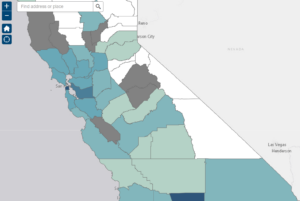
The COVID-19 pandemic has renewed concerns about social and structural factors related to health disparities, including those related to HIV. The Lens tool is a partial response to an urgent need to understand whether elevated risk of COVID-19 disease and mortality among persons living with HIV (PLWH) results from related risk behaviors, a higher burden […]

Lens: HIV Prevalence and Mpox Vulnerabilities – A Data Mapping Tool

December 19, 2023

The 340b program provides an important revenue source for many HIV clinics and facilities, but that revenue is dependent on drug pricing. The Inflation Reduction Act of 2022 introduced provisions to curb drug pricing. Our modeling suggests that 340b revenues generated from HIV-related prescriptions could decrease by as much as 50% if drug prices are […]

Impact of the Inflation Reduction Act on the 340B Program

December 4, 2023

A new CHPRC analysis reveals California pharmacists’ preferences for implementing pharmacist-initiated PrEP for HIV prevention under Senate Bill 159. In a discrete choice experiment, pharmacists preferred implementation scenarios in which they play an active role in the PrEP provision process. However, their preferences around pharmacy workflow suggest that integrating new services requires increased workforce capacity.

Preferences for pharmacist-initiated PrEP implementation in California: Results of a discrete choice experiment

October 20, 2023

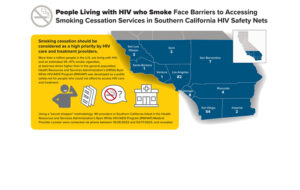
A new study from the California HIV/AIDS Policy Research Centers finds that less than 30% of safety net providers in the Ryan White HIV/AIDS Program in Southern California offered smoking cessation services, and more than 50% do not offer smoking cessation services or referrals. Most providers’ (83%) websites did not list any smoking cessation information. […]

People Living With HIV who Smoke Face Barriers to Accessing Smoking Cessation Services in Southern California HIV Safety Nets

May 15, 2023

Recent trends suggest that declines in California’s adult tobacco use rates have stalled in the last few years, which has serious implications for reversing the substantial progress made in California to reduce tobacco-related diseases. Sexual and gender minorities (SGM) are more likely to use tobacco compared to their heterosexual and cisgender peers. Compared to their heterosexual, […]

Tobacco Use among Sexual and Gender Minorities and People Living with HIV in California

September 10, 2018

To improve accessibility of PrEP services, the California Department of Public Health has been authorized to develop a PrEP financial assistance program that will be modeled after the AIDS Drug Assistance Program (ADAP). We conducted a study of the current ADAP enrollment system to identify best practices that could be incorporated into the new PrEP […]

Financial Assistance for PrEP

September 20, 2017